





Our lives are increasingly shaped around screens. We work through them, connect through them and often turn to them when we want to relax (hello, endless scrolling).
But scrolling does not always feel like rest. More people are rediscovering analog experiences that give their hands something to do and their minds somewhere to settle.
Puzzles offer one simple way back. They replace constant updates with a tactile challenge that unfolds slowly, piece by piece.
1. They engage your hands
Picking up, turning and placing puzzle pieces involves physical manipulation, fine motor control and hand-eye coordination. It is a small but satisfying reminder that not every experience needs to happen through a screen.
2. They strengthen spatial thinking
Every piece asks you to consider shape, orientation and physical relationships. Puzzle solving engages visuospatial abilities such as perception, mental rotation, working memory and reasoning, according to research involving adult puzzlers.
3. They encourage patience and persistence
A puzzle rarely provides an instant answer, which means no instant gratification like we are used to. You try a piece, reconsider it and return to the challenge from another direction. That slower rhythm makes persistence part of the experience rather than an obstacle to it.
4. They invite cognitive connection
Puzzle solving asks the mind to notice colour, shape, pattern and context while connecting small details to a larger image. Research suggests that jigsaw puzzling recruits several cognitive abilities at once, although it should not be treated as a guaranteed way to improve or protect cognition.
5. They create space for presence
When your attention is focused on the piece in your hand, it becomes easier to settle into the moment in front of you. A puzzle can become a quiet ritual shared over coffee, conversation or a few unhurried minutes alone.
6. They offer tactile satisfaction
Texture, weight and movement give analog experiences a sensory quality that digital activities cannot fully reproduce. The feeling of sorting, touching and connecting physical pieces is part of what makes the process so grounding.
7. They build resourcefulness
Where do you begin: corners, colours or recognizable details? Puzzling encourages you to organize information, test strategies, change direction and develop your own way through a challenge.
Why analog experiences matter now
This is not about rejecting technology. It is about creating a healthier contrast to the speed and distraction that can fill so much of the day. Analog activities give us permission to move more slowly, work with our hands and enjoy progress without needing to share or optimize it.
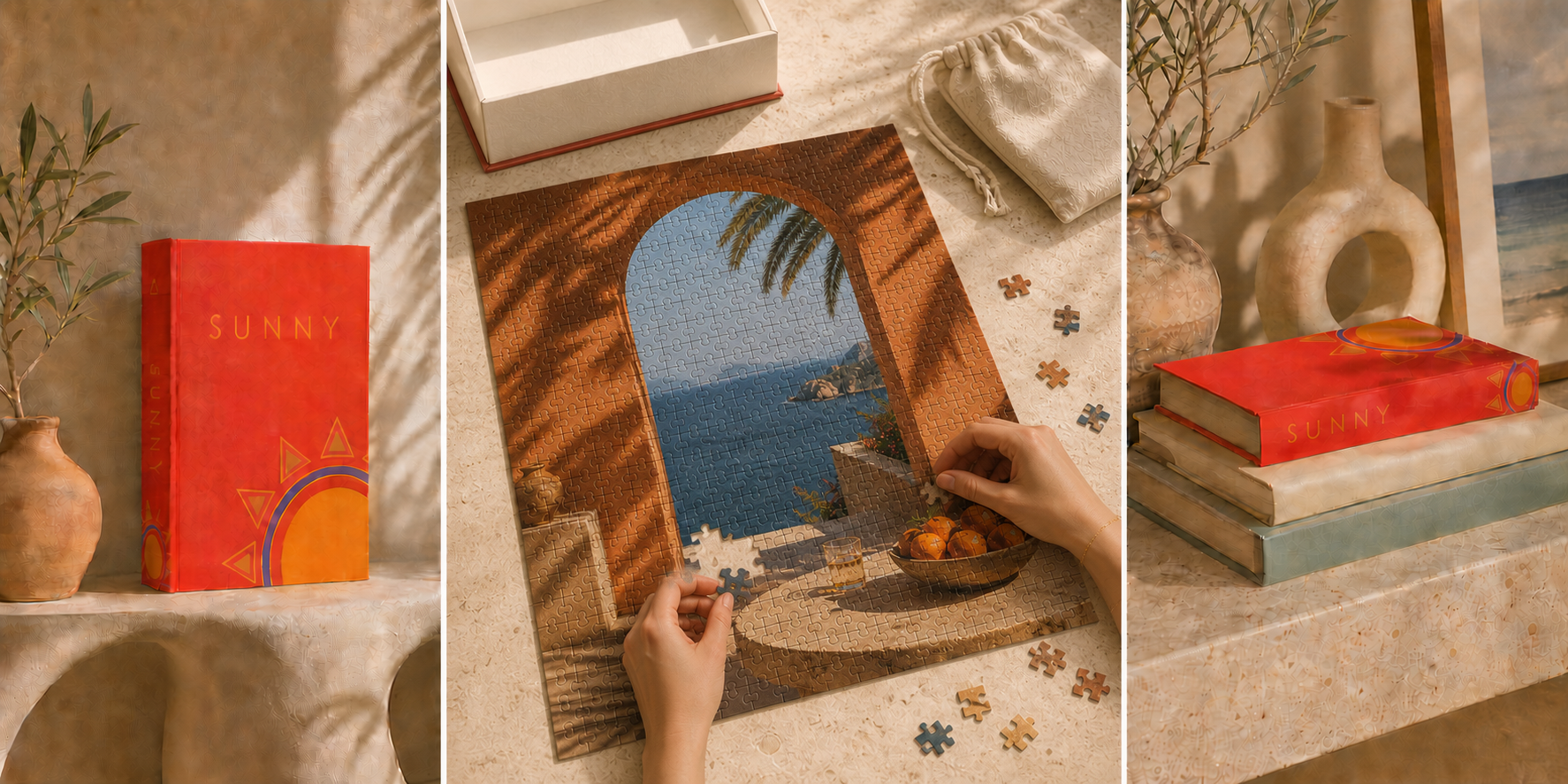
At LOEFT, we believe these experiences can also be beautiful. Our faux coffee table books have a premium linen-textured finish and open to reveal collectible photographic puzzles designed for slower, more intentional moments.
Because sometimes the best kind of scroll break begins with picking up a piece.
Explore Hello, Coastline and find the edition that feels like you.
Research
Research involving cognitively healthy adults found that jigsaw puzzling engages multiple visuospatial and cognitive abilities, while also emphasizing that evidence for broad short-term cognitive improvement remains limited. Additional research has examined the relationship between jigsaw puzzle solving, mental rotation and other visuospatial abilities in adults.